

Articles >
PAYE Reconciliation Guide for UK Employers
April 08, 2026
PAYE reconciliation is one of the most effective ways to keep your payroll accurate and avoid costly mistakes, especially when checking that your figures match HMRC records. Many business owners only realise its importance after HMRC reports a different PAYE balance or when their payroll figures do not match HMRC records. This often leads to confusion about whether PAYE has been underpaid, overpaid, or reported incorrectly.
In our earlier guide on what payroll errors are really costing your business and how to fix them fast, we explained how small payroll mistakes can quickly turn into financial and compliance issues. PAYE reconciliation is the practical step that helps you identify and correct those errors before they escalate into larger payroll discrepancies.
If payroll errors are the problem, PAYE reconciliation is the process that keeps everything under control.
What is PAYE reconciliation
PAYE reconciliation is the process of comparing your payroll records with HMRC records to ensure that all tax, National Insurance, and other deductions are accurate and that your payroll figures are fully aligned.
Each time you run payroll, you submit data through the RTI system. HMRC records those figures, but they rely entirely on the accuracy of what you send. Over time, even minor errors can lead to differences between your records and HMRC figures, making it harder to keep payroll accurate.
Reconciliation ensures both sets of figures match and helps you quickly identify why PAYE figures do not match HMRC records.
Why PAYE reconciliation matters
Payroll errors rarely happen in isolation and are often the reason payroll figures do not match HMRC records. A wrong tax code, a missed leaver, or an incorrect submission might seem minor, but they are common reasons for PAYE discrepancies and HMRC balance differences.
As explained in our guide on payroll errors and their real cost to your business, these mistakes can result in financial loss, compliance risks, and ongoing differences in payroll reporting. PAYE reconciliation serves as a safeguard by providing you with a clear and regular comparison between your payroll data and HMRC records.
By reconciling PAYE regularly, you can
- Avoid unexpected tax demands
- Reduce the risk of HMRC penalties caused by incorrect PAYE reporting
- Identify and correct payroll errors early before they affect reported figures
- Maintain accurate financial records
Instead of dealing with problems at year end, you stay in control throughout the year.
When to reconcile PAYE
PAYE reconciliation should not be left until the end of the tax year.
A more effective approach is to carry out checks regularly
- After each monthly payroll run
- At least once every quarter
- A final review after 5 April
Regular checks allow you to identify discrepancies early, when payroll differences are easier to trace and resolve.
Common PAYE reconciliation mistakes
Many PAYE discrepancies are caused by common payroll errors that build up during the year and affect your reported figures.
These are some of the most common reasons why PAYE does not match HMRC records.
- Incorrect tax codes
HMRC issues tax code updates throughout the year. If these are not applied correctly, deductions will not match HMRC expectations.
- Missing leaver information
If an employee leaves and this is not reported correctly or on time, HMRC may continue to expect payroll submissions for that individual.
- Errors in starter details
Incorrect starter declarations can lead to wrong tax calculations from the beginning of employment.
- Unrecorded adjustments
Manual corrections to payroll that are not properly reflected in submissions can create inconsistencies.
- Incorrect year to date figures
Errors in year-to-date totals, especially at the start of a new tax year, can affect every submission that follows.
These issues are closely linked to the types of common payroll errors in your business, but PAYE reconciliation is where those mistakes become visible when compared against HMRC records.
How to reconcile PAYE with HMRC step by step
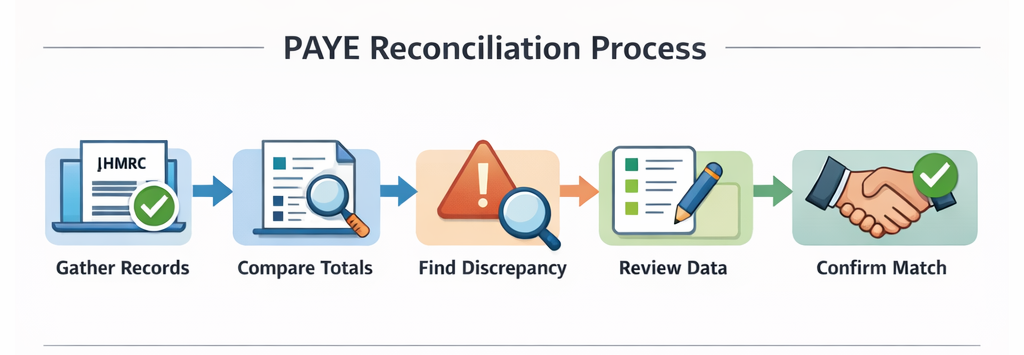
PAYE reconciliation does not need to be overly complex, especially when you are trying to identify why your PAYE does not match HMRC records. A structured approach makes it manageable.
Step 1 Gather your records
Download your HMRC employer statement and collect payroll summaries from your software.
Step 2 Compare totals
Check the year-to-date totals from HMRC against your payroll records to confirm both sets of figures match. These figures should match exactly.
Step 3 Identify the discrepancy
If there is a difference, review each pay period to find where the mismatch between payroll and HMRC began.
Step 4 Review employee data
Check tax codes, pay, and deductions for employees in the affected period to locate the issue.
Step 5 Correct the error
Submit corrected information through an updated FPS or EPS, depending on the type of PAYE error identified.
Step 6 Confirm the reconciliation
Check HMRC records again to ensure the figures now align.
Once you understand how payroll errors occur, this process becomes much easier to manage and control.
What happens if PAYE is not reconciled
Failing to reconcile PAYE can lead to a range of issues, especially when differences between payroll and HMRC records go unnoticed.
These include situations where HMRC shows a different PAYE balance than your payroll records
- Unexpected payment demands from HMRC
- Penalties for inaccurate or late submissions
- Time spent resolving discrepancies
- Increased likelihood of HMRC scrutiny
In some cases, businesses may even pay amounts twice due to unresolved differences between payroll records and HMRC data.
How a payroll specialist can help
PAYE reconciliation requires consistency and attention to detail. While it can be handled in house, many businesses choose to work with payroll specialists to reduce risk and save time.
A payroll accountant can
- Monitor payroll accuracy throughout the year
- Ensure tax codes and employee data are up to date
- Submit accurate RTI reports
- Identify and resolve discrepancies quickly
This approach allows you to focus on running your business while ensuring your payroll remains compliant and accurate.
Frequently Asked Questions
- How often should PAYE be reconciled?
PAYE should be checked regularly, ideally after each payroll run, with a more detailed review carried out quarterly and at the end of the tax year.
- Why does PAYE not match HMRC records?
Differences are usually caused by incorrect tax codes, missing employee updates, or errors in payroll submissions.
- Can payroll software prevent discrepancies?
Payroll software helps reduce errors but does not eliminate them. Regular reconciliation is still necessary.
- What should I do if PAYE does not match HMRC records?
You should identify when the issue started, correct the data, and submit updated information to HMRC.
- How can I check my PAYE balance with HMRC?
You can check your PAYE balance by logging into your HMRC employer account and comparing it with your payroll reports to identify any differences.
Get help with PAYE reconciliation
PAYE reconciliation is not just a compliance task. It is a practical way to stay in control of your payroll and avoid the financial impact of errors. If you have already explored what payroll errors are really costing your business, PAYE reconciliation is the step that ensures those issues are identified and resolved properly.
If your PAYE does not match HMRC records or your HMRC balance does not look correct, or if you have noticed differences in your payroll figures, getting professional support can save time and prevent unnecessary penalties. Our payroll specialists can review your records, correct discrepancies, and ensure your payroll is fully compliant.