

Articles >
MTD ITSA 2026: How to Connect Payroll and CIS Without Duplicate Work
March 24, 2026
From April 2026, many UK businesses will need to follow new rules under Making Tax Digital for Income Tax Self Assessment (MTD ITSA). If your income is over £50,000, you will be required to keep digital records and submit quarterly updates to HMRC instead of relying only on an annual tax return. For most business owners, the concern is not the rules itself but the extra work. If you already manage payroll through RTI or submit CIS returns, the real question is:
How do you connect everything without repeating the same work every quarter?
This guide explains how to link your systems properly so your MTD ITSA quarterly updates are accurate, efficient, and far less time-consuming. If you are new to the rules, start with our MTD ITSA guide for sole traders and landlords, then return here for the practical setup.
What is MTD ITSA Software Integration?
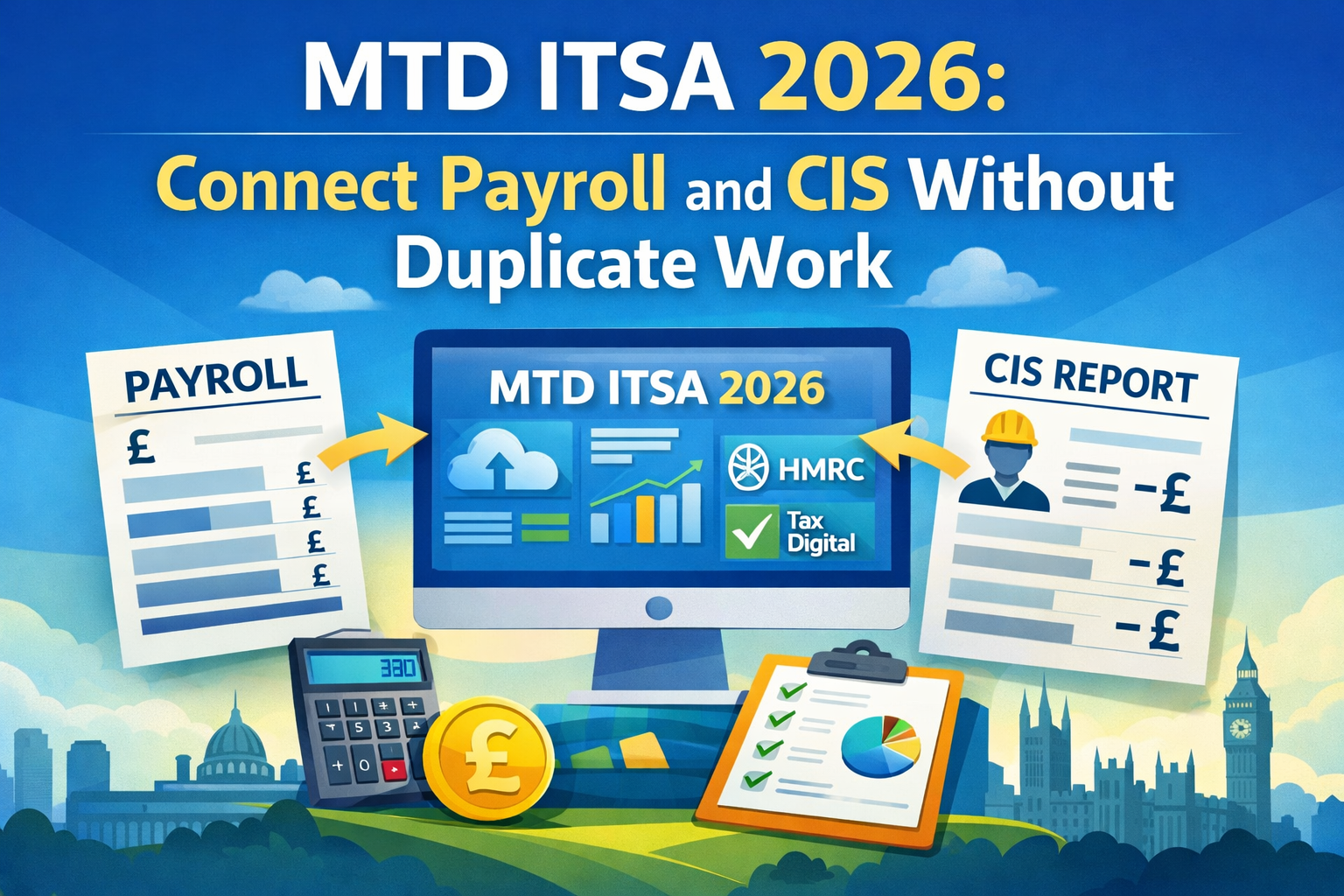
MTD ITSA software integration connects your accounting records, payroll, and CIS data so that your quarterly updates are generated automatically.
Instead of:
- Manually entering payroll figures
- Copying CIS deductions
- Adjusting totals at the end of each quarter
Your software pulls everything together through secure HMRC connections.
For many UK businesses, this reduces reporting time significantly and lowers the risk of errors. Some businesses also use payroll processing services to ensure payroll data is consistently structured and ready for MTD ITSA reporting.
Why MTD ITSA Integration Matters
As part of MTD ITSA requirements, each quarterly update requires you to submit:
- Total income
- Allowable expenses
- Net profit or loss
The difficulty is not in collecting this information. It is making sure the figures match across different systems.
Without proper integration, businesses often:
- Re-enter the same data multiple times
- Deal with mismatched figures between payroll and accounts
- Spend hours correcting errors before submission
With the right setup:
- Payroll data flows directly into your reports
- CIS deductions align with your totals
- Your MTD quarterly updates become a simple review process
Struggling with MTD ITSA software setup? Contact Us Now
Choosing the Right MTD Software in the UK
All-in-one software
Cloud platforms such as Xero, QuickBooks, and Sage allow you to manage bookkeeping, payroll, and submissions in one place.
This approach works well for:
- Small businesses with employees
- Contractors dealing with subcontractors
- Businesses looking to automate reporting
Bridging software
Bridging tools connect your spreadsheets to HMRC while keeping your existing setup.
This is often suitable for:
- Landlords
- Smaller businesses with simpler records
Choosing the wrong system can lead to missing data or reporting issues. Many problems we see come from businesses assuming their current setup will automatically meet Making Tax Digital software requirements.
You can also review common MTD ITSA mistakes landlords should avoid to understand where things typically go wrong.
How to Connect Payroll to MTD ITSA Software
If you already run payroll, most of the data you need for MTD ITSA payroll integration is already available.
A properly connected system works like this:
- Payroll continues under RTI as usual
- Your software pulls totals such as gross pay and employer contributions
- You review the figures before submitting your quarterly update
The issue arises in how the data is mapped.
If payroll categories do not align correctly with your accounts, your figures may not match your MTD submission.
For a clearer picture, it helps to understand how payroll affects your self-assessment reporting.
CIS and MTD Integration Explained
For contractors, understanding CIS and MTD ITSA is often the most important part of the process, especially when learning how to report CIS under MTD ITSA correctly.
CIS returns already include:
- Payments to subcontractors
- Tax deductions
Under MTD ITSA, these figures must also appear correctly in your quarterly totals.
Without integration:
- CIS figures are copied manually
- Errors are more likely
- Reconciliation takes longer
With the right setup:
- CIS data is pulled automatically
- Figures stay consistent across submissions
- Reporting becomes faster and more reliable
This is particularly important for those searching for MTD ITSA for contractors.
To understand the risks, see CIS returns and avoiding HMRC penalties.
Practical Setups for Landlords and Small Businesses
Landlords
Those managing rental income often use separate tools for property records and occasional payroll.
Integration ensures that all figures feed into one quarterly update, reducing duplication and improving accuracy.
This is a key step for anyone dealing with MTD ITSA for landlords.
Small businesses
Businesses with regular income, staff, and expenses benefit from having everything connected in one place.
It allows:
- Clearer financial visibility
- Consistent reporting
- Fewer last-minute adjustments
For many, moving to proper integration is also the first step towards better MTD compliance overall.
Common MTD ITSA Mistakes to Avoid
- Systems not properly connected
- Incorrect settings blocking data flow
- Differences between payroll, CIS, and accounts
- Relying on manual adjustments
Most of these are avoidable with early setup and testing. In more complex cases, a tax accountant can help identify gaps in your setup and ensure your reporting remains accurate across all submissions.
You can explore tax planning strategies for small businesses to see how better systems also improve long-term efficiency.
Using the 2026 to 2027 Grace Period
HMRC has confirmed a soft landing period for the first year of MTD ITSA. There will be no penalty points for late quarterly submissions from 2026 to 2027.
However, digital record keeping is still required from the start.
This gives you time to:
- Test your setup
- Correct any issues
- Build a reliable reporting process
Businesses that act early are far better prepared when stricter enforcement begins.
Take Action Before April 2026
MTD ITSA does not need to increase your workload.
With the right setup:
- Payroll connects automatically
- CIS data flows into your reports
- Quarterly updates take far less time
We offer a free 30-minute MTD ITSA setup review where we:
- Assess your current systems
- Identify any gaps
- Explain how your data will flow into MTD
If you want to avoid unnecessary work and ensure everything is ready before April 2026, this is a practical place to start.
FAQs: MTD Software Integration
Do I need software for MTD ITSA?
Yes. HMRC requires digital record keeping and submissions through compatible software.
Which is the best MTD software in the UK?
It depends on your setup. Businesses with payroll and CIS often benefit from all-in-one platforms, while simpler setups may use bridging tools.
Can I use spreadsheets for MTD ITSA?
Yes, but only with bridging software that creates a compliant digital link.
How to report CIS under MTD ITSA?
CIS figures must be included in your quarterly updates. Proper integration ensures they are pulled automatically and reported correctly.
Most businesses are not concerned about MTD rules; however, they are concerned about the time it takes to comply. With the right MTD ITSA software integration, your systems work together, your figures stay consistent, and your reporting becomes far more manageable.
That is what turns MTD from a burden to a process you can handle with confidence.